Thursday, 30 April 2015

Venice Project Overview

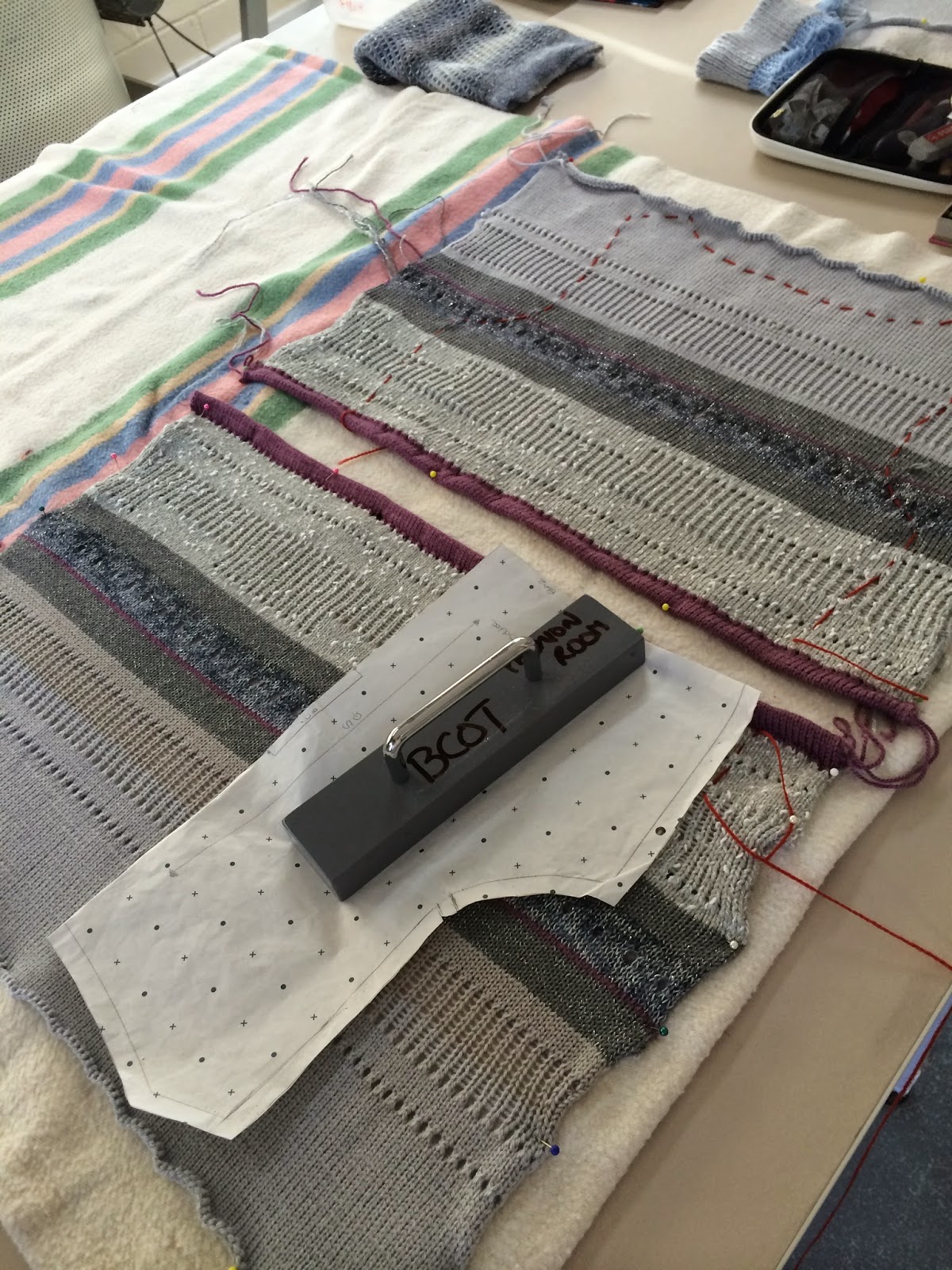
Back in October 2014 our group visited Venice to gather inspiration for our first project of the second year. Below are photos of the knitting and construction of my final outfit of the Venice project which was made up of a crop top and culottes. This was the first knitted outfit I have ever attempted to make. 

The sleeves for my top took a very long time to knit as the lace carriage wouldn't work with my yarn. Instead of using the lace carriage I transferred each stitch by hand to create all of the lace holes. The crop-top was relatively straight-forward to knit although it was also the first time that I had knitted a hem.

The culottes consisted of four identical knitted lengths of fabric which featured a complicated pattern made of five different yarns, each with their own colour and texture.

Considering this was the first knitted outfit I've made, I was extremely pleased with the final result.

The knit for the sleeves still on the knitting machine

A close up of the sleeve knit

Hooking up the hem of the crop top

Knitting on the machine for the culottes

The final four pieces of knit for the culottes

Laying my pattern onto the fabric of the crop top

Pinning the fabric of the culottes ready to be steamed

Another piece of fabric pinned ready to be steamed

Marking out pattern pieces ready to cut

Pattern pieces marked out to be cut

Sleeve material marked out ready to be cut

The waistband of the culottes on the linking machine

The final garment with all of the supporting work

Samples and toiles

Monday, 16 March 2015

Blue Inspiration


My inspiration for this project is waves and breaking water. Initially I dyed my yarns and I thought that the tones of blue I had created reminded me very much of the sea. I will be including shades of white, cream and silver into my colour palette which works perfectly with the waves idea. From looking at the structure and patterns of different waves I have realised that they are all different and completely at random. I shall therefore try to avoid repeating myself with techniques and colour blocks when doing my samples so that they relate better to my inspiration. I am looking forward to trying out different techniques to try and create the different wave themed samples I am hoping to achieve. 


Sunday, 15 March 2015

Blue Project


Dying Final Yarns

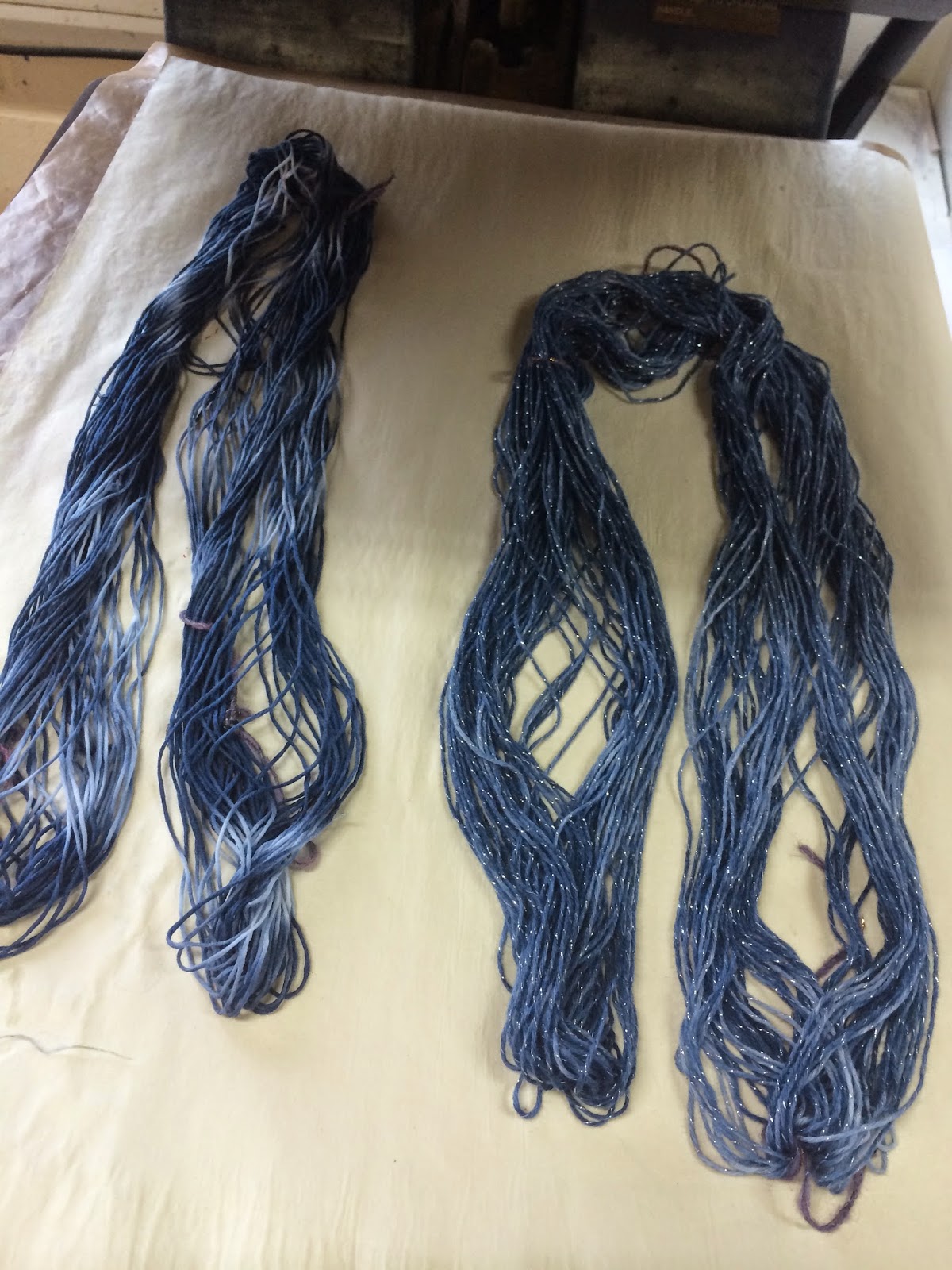
I have been dying my final yarns that I will use for the 6 samples I need to produce as part of my Blue project. I have chosen to use the two processes of Indigo dying and Acid dying. I enjoyed using Indigo dying as I found that I could get some really nice results in quite a short amount of time. Using the Acid dying technique I managed to achieve some really lovely colours that I was pleased with.

My inspiration for this project has been waves and I think I will be able to replicate this theme well through my samples, as the colours that I have produced lend themselves really well to the colours associated with water and breaking waves. I will also be mixing silver, white and cream in with my blue yarns to enhance the effect further.


Monday, 9 February 2015

Modelling on the Stand workshop 1


MOTHS (Modelling on the stand)

The three final outfits from the groups.

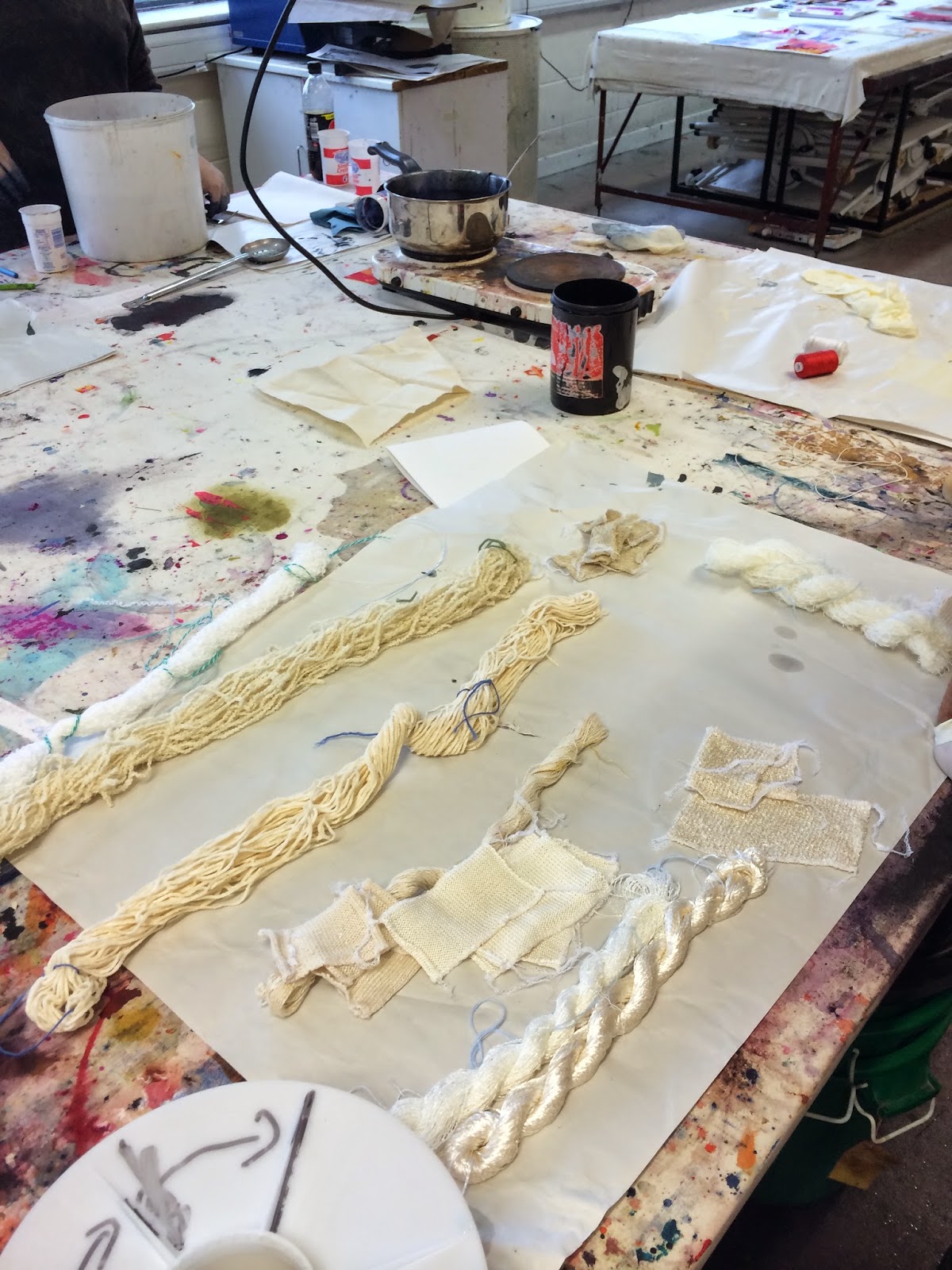
The next project for me in my fashion studies lesson is MOTHS. Over the next few weeks I will undertake a few different types of workshops which will result in me having a final garment. This was the first week of the project. We were firstly paired up and then given a pack of calico with a selection of pre cut squares and circles of different sizes. We could cut into them, sew them, pin them and fold them to create an outfit. Below are some pictures of the techniques we tried. Some we tried and used and other we didn't. This was a very creative task and I found it much harder than I had imagined.  


I hope to continue with post about future workshops.

Sam


x

Wednesday, 4 February 2015

Latest Project - Blue


Yarn Dyeing

This week was the first week of my new project which focuses on the colour blue. As a knitter, we are required to dye our own yarns which we will come to use later on in the project. This week saw me experimenting with different types of yarn and dye to find a suitable combination to use.

I'm not particularly comfortable with being in the print room and dyeing but it turned out to be much more enjoyable than I initially thought that it would be. It was a good experience and the group shared ideas and I got some interesting results from my experiments.  Below are some photos of the day.


The skeins of yarn I made ready to be dyed.


 All of the skeins the group made to be dyed split up into yarn types - wools, cottons, silks, polyester etc..


On the left I am using navy acid dye and on the right Karen is washing out yarns.


Above is Karen indigo dyeing and on the right is Nicole using procion dye.


I wanted a dip dye effect so here I am using procion dye and dipping half and half into different shades.


Here are some of the different results we all got from this workshop.


 On the right are all my yarns that I bought and dyed.


I am hoping to write some more blog posts in the future to show some of the further steps of this project.

Sam

The Subversive Stitch


The Cover page

The Subversive Stitch by Rozsika Parker was first published in 1984.  Another edition was published in 2010 that had been rewritten as a more up to date evaluation embroidery and its relationship with the status of women throughout history.

Rozsika Parker uses many sources to back up her assessment of the history of embroidery and role that its separation from being considered an art form had on women.

Below are two reviews of the book which I found helpful in understanding the context of the book.

"It isn’t often that a book changes your life, much less so a book which isn’t a novel or a self-help guide!
The Subversive Stitch, however, genuinely did change mine. This seemingly dry anthropological study of the history of women embroidering helped me place myself in context as a contemporary needlework artist.
I already knew that I came from a long lineage of women who stitched, and indeed I learned to embroider from both my grandmothers. Sharing this craft and skill with them was an important bonding experience during my transition from childhood to womanhood.
However, as a feminist it was sometimes difficult to align myself with a craft which over the course of its history has arguably been used to subdue women, keeping them docile and obedient.Rozsika Parker doesn’t shy away from exploring this side of embroidery’s history, drawing on the writing of proto-feminists such as Mary Woollstonecraft and Mary Lamb, who were vehement detractors of the craft.
However, even as early as the 17th Century women were subverting the medium in samplers which proclaimed their freedom, individuality and refusal to bow to the status quo. Learning this from The Subversive Stitch really appealed to me as a writer and conceptual artist who employs embroidery as a means of self-expression (and sometimes dissent)."


Sampler

"From my reading of this book, I came to understand the reasons the disparity in status between embroidery and painting. The division between women's work and men's work seems to be at the core of this deep seeded antipathy towards embroidery. This particular quote from the eighteenth century sums it up:  "Sir, she's an Artist with her needle....Could anything be more laughable than a woman claiming artistic status for her sewing?" (page 172).  Luckily, today's definitions of art and femininity are somewhat more fluid, allowing me flexibility to chose the medium best suited for a particular message"


Original and revised editions

Examples of Subversive Stitch


References

Rolison, K. (2013) 'Book Review: The Subversive Stitch: Embroidery and the Making of the Feminine by Rozsika Parker', Significant Seams 02 January [Online]. Available at: http://www.significantseams.org.uk/2013/01/02/book-review-the-subversive-stitch-embroidery-and-the-making-of-the-feminine-by-rozsika-parker/ (Accessed 04 February 2015).

Mida, I. (2010) 'Book Review: The Subversive Stitch, Embroidery and the Making of the Feminine', Fashion is MyMuse 29 July [Online]. Available at: http://fashionismymuse.blogspot.co.uk/2010/07/book-review-subversive-stitch.html (Accessed 04 February 2015).


Wednesday, 10 December 2014

Research into Modern Gypsy Wedding Dress Traditions

As part of this year’s assignments I have to write an essay exploring an area of my choice. For my research I decided to look at gypsy weddings, with a particular focus on the dresses of both the brides and bridesmaids. As with most traditional weddings, the wedding dress in a gypsy wedding is an extremely important aspect of the ceremony.

Most people are familiar with Channel 4’s programme ‘My Big Fat Gypsy Wedding’. What many people are not aware of are the books that have been published on the subject since. These books go further than the programme and offer a closer look at traveller lifestyle and culture.

Thelma Madine
One of the most recognisable people in ‘My Big Fat Gypsy Wedding’ is Thelma Madine, who has also written a number of books about her experiences with the traveller community. Thelma is a dressmaker and business owner whose shop ‘Nico’ in Liverpool has attracted many traveller families over the years. Thelma is known for producing all types of dresses for special occasions including for weddings, communions and christenings.

Thelma Madine and a member of her team
I have been researching using Thelma’s and Jim Nally’s books to get a better understanding of modern gypsy wedding traditions and culture. This has included looking at some of the most popular styles of wedding dress amongst traveller brides as well as the reasons behind them wanting such extravagant designs.

Below are a few examples of the kinds of dresses that are popular with many traveller brides.