Showing posts with label fashion. Show all posts

Wednesday, 23 March 2016

Dissertation Reflection

The Royal Family is a subject that I have always been interested in. I began reading around the subject before deciding on my research question. This helped me choose the direction of the project. There was lots of information available and I had to narrow down what I was going to use.

I used a few key resources that provided in-depth information about Diana and her life.  As well as these I used some articles that can be found online.  Most of these articles were written more recently and look back on Diana's life.  Today it's easy to find articles that were published during the internet era, however finding articles from whilst Diana was alive is much harder because there are no easily accessible digital copies. If I were to research again, I might plan time to research and visit somewhere where hard-copies of these kinds of resource are available.

Writing is something that I am not confident in and as such I have had to be very organised during this project. I had to make drafts of my work, read over and slowly make improvements with help and advice. I had to refer back to the project brief and my own project plan to keep on track and schedule in enough time to complete the dissertation and research file in time for the deadline.

The planning and organisation that I needed to use to complete this written assignment has made me realise that there are improvements that can be made in other areas of my studio work.

This dissertation has really caught my interest with the Royal Family and in particular Diana. Since completing the project I have continued to read around the subject and I have even been to visit Kensington Palace to see an exhibition that included many of Diana's dresses.


Thursday, 25 February 2016

Literature Review Final Dissertation

 Diana her life in fashion


Diana Her Life in Fashion (Howell, 1998) is the resource that I have most used during my research as it has the most relevant research into her life from a perspective of fashion. “What message will I be giving out if I wear this?” (Howell, 1998, p.14). This is a quote from Jasper Conran, one of Diana’s favourite British designers, which appears in the introduction of Howell’s book and illustrates the connection of the book to the fashion theory of Semiotics.  The book refers throughout to Diana’s fashion and how she was using it through different stages of her life, both before marriage and during marriage, and in the short time after her divorce. The book also details the history of what was happening in the times of her life and how events played out. Not everything in the book is directly relevant to my question but even those parts are very important in providing background information and context.

Diana Woman of Style


Diana Woman of Style (Modlinger, 1998) is another book that I have looked at during my research. It contains a good number of interviews with the designers she used most during her life. The book has detailed information on key dresses and outfits she has worn. For example, the ‘Wedding Dress’ and the ‘Revenge Dress’. The book was particularly helpful for researching about the ‘Revenge Dress’ and it even includes a fashion illustration for the original design of the dress. I found this book to have very similar information to another book that I have been using, Diana Her Life in Fashion, which has been useful to back up and confirm what I have learnt from Diana Woman of Style.

 Royal Style


Royal Style (Wackerl, 2012) is a book that looks at Royal fashion from all over the world and has a section on Princess Diana. Despite being in only a short chapter of the book, the author really manages to highlight many of the key outfits that Diana became well known for in the eyes of the media and public. In this book it refers to her fashion biography, Diana Her Life in Fashion (Howell, 1998), which it uses a quote from and that I have used as an important source for this research project. Royal Style was helpful in the initial stages of my research as it gives a short overview of Diana’s life as a fashion figure in the public eye.

Tuesday, 21 July 2015

Julian Roberts Dress for MOTHS

Here are photos of my final dress made for the Modelling on the Stand (MOTHS). To create this dress I used the Julian Roberts pattern cutting technique. I had previously tried this technique twice so I felt quite confident in making my final dress using it. Using the two fabrics for the dress was not an easy task as they were both light weight and difficult to handle. I tried to recreate the toile that I had made for the dress earlier in the project, however it did not work well with the lighter fabric so I changed and adapted my approach. I played around with different pieces, pinning them in different places, until I was happy with the result. 

Overall I am really happy with how this project has gone and how my final dress has turned out. It was good to try new techniques and to work outside of my comfort zone.

Drawing on the bodice pattern.

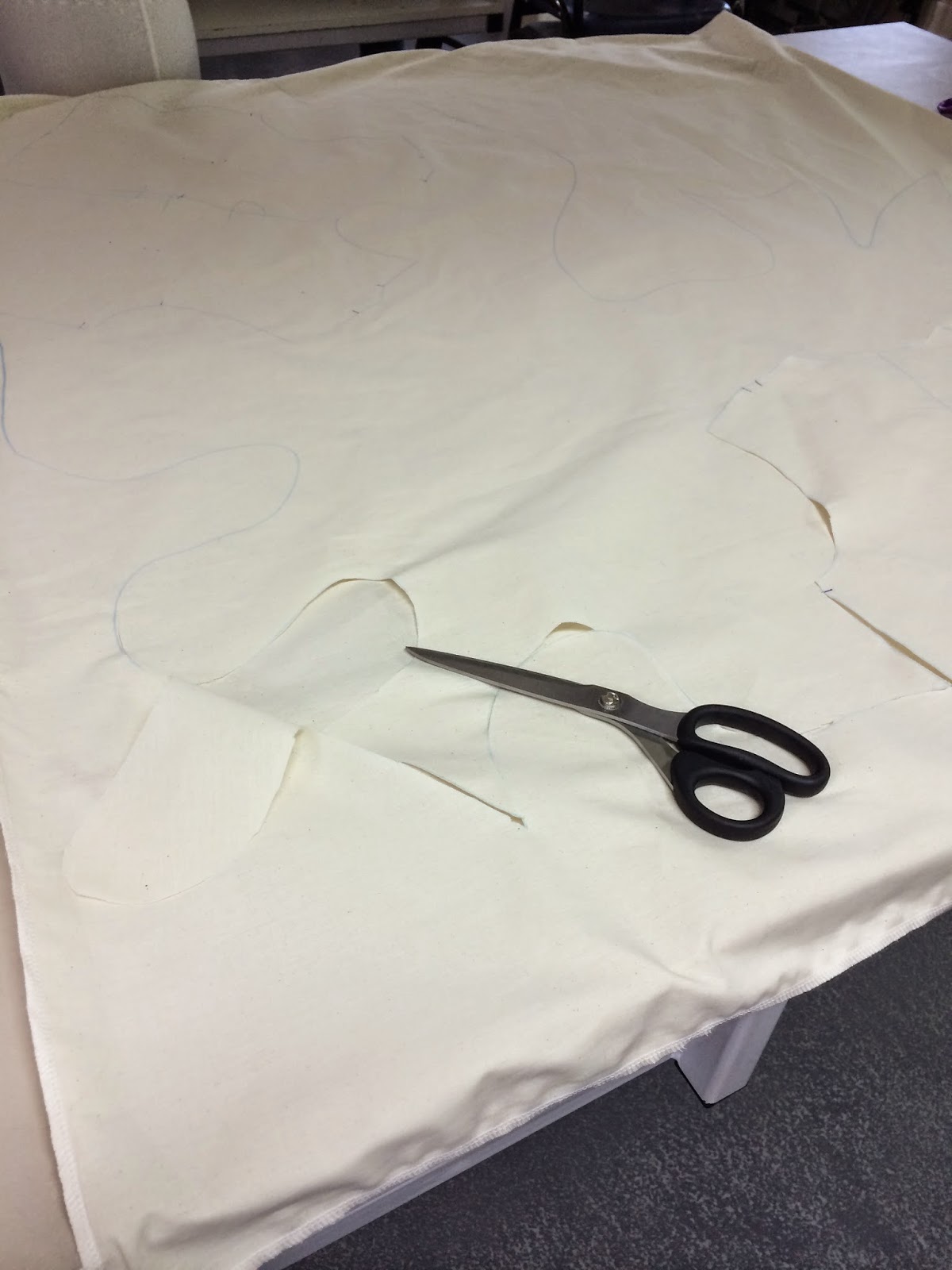
Cutting out the dress.

All of the fabric removed.

Me holding the shoulder seams together, before anything was sewn. 


The back view of my complete dress. 

The front view of my completed dress.

Close up of the hand sewn gather. 

Close up of the invisible zip.


Julian Roberts Toile for MOTHS

For my final garment for the Modelling on the Stand project (MOTHS) I made a toile. Below are a series of photos that show some of the stages of this process.

I used the Julian Roberts pattern cutting technique to construct my garment. I experimented with two fabrics of different weights that were slightly different colours so that I could see how it might work in my final garment. The photos that I have taken during the process will help me to recreate the bottom half of the garment when I come to make the final dress as this section has no set paper pattern. 


Sunday, 31 May 2015

CAD boards

Here are two of the mood boards that I have made during my CAD lessons. They are both inspiration for the Live Whitchurch silk mill project.


Monday, 4 May 2015

Blue Project Presentation

For my Blue project I was required to complete a mood board, an illustration, technical drawings and fashion flats, a technical file and six final samples. 

My inspiration was waves which I discussed in an earlier blog post. I think that my results tied in very closely to my theme and I replicated it well with my final knit samples. I hand-dyed all of the yarns that I used in these samples and this was an achievement for me as it's not something that I would normally do. Working with a small colour palette was also a challenge but it was interesting as it allowed me to focus more closely on depth and tone. I really enjoyed working on this project and was pleased with my final results. The photos below are of the presentation of the project in my base space.

Sam


MOTHS Workshop 4 - Julian Roberts

The fourth MOTHS workshop was the last of the sessions for this project. This workshop was given by a third year student who had particularly enjoyed this part of the project last year. The workshop covered a technique called Subtraction Cutting which was found by pattern cutter Julian Roberts. Initially I found the concept quite hard to get my head around but I was reassured that it would click eventually.

The process was: We had two metres of fabric cut in half which we sewed together to make a bag. We laid the bag flat on the table and drew out two bodice blocks at random points on the fabric, marking the darts too. We then drew a line connecting the bodice blocks together. Next we had to cut in to the top layer of the bag to cut out the shape of the lines that we had marked on, cutting around the bodice blocks too. After this was cut we sewed the darts into the bodice and then the shoulder seams together. It was at this point that I began to understand how this technique works. I pulled the dress up and could see how it was going to take shape. The next part was sewing the rest together however you liked to make the final dress. This is the technique that I have decided to use to make my final dress for this project.


All of our dresses that came out of the workshop. (mine's the one in the middle)

MOTHS Workshop 3


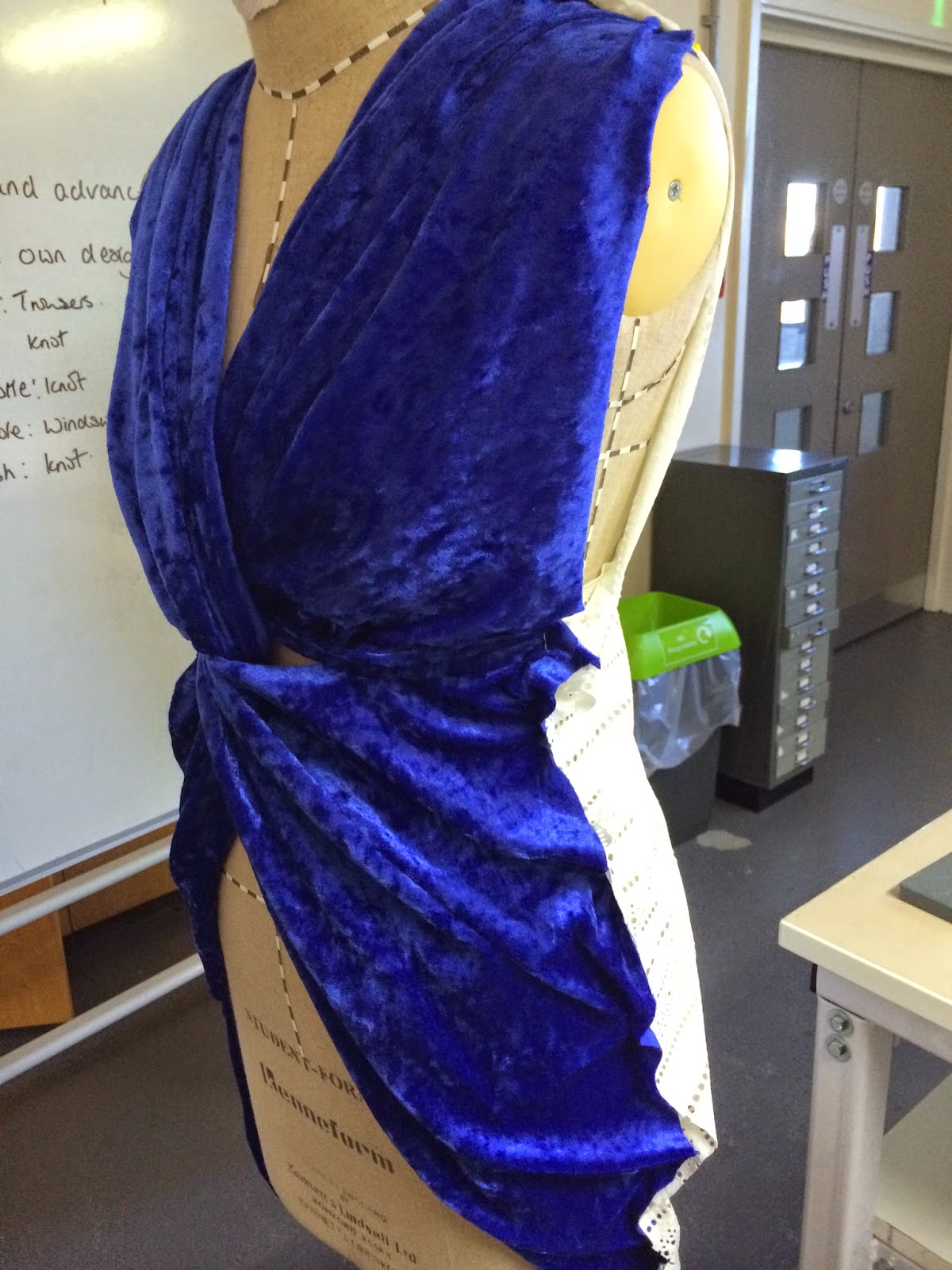
During the third MOTHS workshop we worked from a selection of handouts and chose a technique that we wanted to try. I chose to try the knot technique. This was easier than I initially thought that it might be so I decided to test the technique in three different types of fabric to see what the results would be. Below are some photos of the results.

Sam


Thursday, 30 April 2015

MOTHS Workshop 2


For the second MOTHS workshop we learnt how to formally model on the stand. Firstly we had to mark out the essential lines using designer tape as shown below.


The next step was to get a piece of calico and pin it to the mannequin along all of the essential lines. We then pinned where the darts would be positioned. We did this for both the front and back. After all of the darts were pinned and the calico fitted the model perfectly, we then used tailor's chalk and marked along all of the essential lines and darts. After doing this it was then ready to be unpinned. When laid out flat onto pattern paper all of the markings can be traced off to make the pattern for the fitted bodice shape which can then used to make a perfectly fitted garment.