Showing posts with label dress. Show all posts

Thursday, 25 February 2016

Final Dissertation Conclusion and References

1.    Conclusion


The research contained within this report suggests that Diana was very conscious of every fashion choice she made. Looking at the different points in time of her public life you can see that see that Diana always had an understanding of the fact she could use Semiology. Her early attempts didn’t always go to plan, even though she had very much thought out each outfit.
The Nursery outfit in 1990, when Diana and Charles were dating, included a skirt adorned with hearts that conveyed her love. This encounter ended up being manipulated by the press.  Her Engagement outfit in 1981 had been chosen by Diana to project the blue sapphire of her engagement ring, however the actual choice of outfit wasn’t really suited to Diana as it was too old-fashioned for someone of her age. The Black taffeta dress, also in 1981, aimed to show Diana as sophisticated and grown up however it back-fired as it was ill fitting and was deemed too daring and revealing. In all three of these examples Diana had an intention of how she wished to be seen but in each case her message was overlooked by the media who found something else to focus on.
By the time of Diana’s wedding she was aware that she required advice and assistance to make sure that there were no more mistakes. Her wedding dress was the outfit which gained the most attention and Diana managed to convey her feelings successfully to the world through it. The message of a dream wedding to a prince and a happy ending was generally what the public saw through the media.
It was during Diana’s married life that she really took control of her image. She was very aware of the media and that whatever she wore would be analysed. She took this knowledge and used it to her advantage on occasions. Milliner Stephen Jones noted this in his meetings with Diana, “When I met the Princess at Kensington Palace she was always interested in the effect – “How will people see this? How will this be interpreted?” “(Howell, 1998, p.80).
Apart from being aware of the messages that she could convey through the media, Diana was also aware of using her outfits during interactions with individuals. This can be seen in the Caring Dress, used by Diana on visits to sick children, and with the change in her fashion choices whilst she was having an affair with James Hewitt.
By 1994 Diana had mastered how to portray herself to the media. This was the year that she wore the Revenge Dress. This dress was the perfect execution of Semiology and author Luise Wackerl in her 2012 book Royal Style noticed the same, saying Never before had a woman selected her outfit with such tactical brilliance.’ (Wackerl, 2012, p.106). Diana managed to convey exactly the message that she wanted to the media without having to say a single word.
Today, naturally Kate Middleton is compared to Diana and it remains to be seen whether she will begin conveying messages through semiotics as clearly as Diana did. It appears that since having children of her own, Kate has taken on board the experiences of Diana and her relationship with both the media and the royal family, and is perhaps starting to shy away from both to focus on her family. If recent news stories are to be believed, it seems that Kate may choose to take a different path to Diana altogether. ‘She is said to loathe the constant comparisons with Diana’ and ‘she also dislikes references to her as a clothes horse’ (Kay, 2015) which shows that Kate is aware of Diana’s relationship with fashion and the media. As a result, ‘it has even been murmured that when the time comes, she might not want to be Princess of Wales at all’ (Kay, 2015).

2.    References

 Howell, G. (1998) Diana her life in fashion. London: Pavilion Books Limited
Craik, J. (2009) Fashion – the key concepts. Oxford: Berg
Kay, R. (2015) ‘Why is Kate becoming the invisible Princess? As she increasingly shrinks from the limelight, the question worried courtiers are whispering... Will the Duchess refuse to be the new Diana?’ Mail Online [Online]. Available at: http://www.dailymail.co.uk/news/article-3206562/Why-Kate-invisible-Princess-increasingly-shrinks-limelight-question-worried-courtiers-whispering-Duchess-refuse-new-Diana.html (Accessed 24 January 2016)
Lusher, A. (2008) ‘Diana's designer reveals the secrets of the Princess's 'caring dress'’ Telegraph [Online]. Available at: http://www.telegraph.co.uk/news/newstopics/diana/3534976/Dianas-designer-reveals-the-secrets-of-the-Princesss-caring-dress.html (Accessed 14 January 2016)
Modlinger, J. (1998) Woman of style Diana. Surrey: Quadrillion Publishing
Neel, J. (2011) ‘Style File – Diana, Princess of Wales’ Vogue [Online]. Available at: http://www.vogue.co.uk/spy/celebrity-photos/2011/04/15/style-file---diana-princess-of-wales/gallery/616479 (Accessed 1 October 2015)

Wackerl, L. (2012) Royal Style. Munich. London. New York: Prestel Verlag 

Literature Review Final Dissertation

 Diana her life in fashion


Diana Her Life in Fashion (Howell, 1998) is the resource that I have most used during my research as it has the most relevant research into her life from a perspective of fashion. “What message will I be giving out if I wear this?” (Howell, 1998, p.14). This is a quote from Jasper Conran, one of Diana’s favourite British designers, which appears in the introduction of Howell’s book and illustrates the connection of the book to the fashion theory of Semiotics.  The book refers throughout to Diana’s fashion and how she was using it through different stages of her life, both before marriage and during marriage, and in the short time after her divorce. The book also details the history of what was happening in the times of her life and how events played out. Not everything in the book is directly relevant to my question but even those parts are very important in providing background information and context.

Diana Woman of Style


Diana Woman of Style (Modlinger, 1998) is another book that I have looked at during my research. It contains a good number of interviews with the designers she used most during her life. The book has detailed information on key dresses and outfits she has worn. For example, the ‘Wedding Dress’ and the ‘Revenge Dress’. The book was particularly helpful for researching about the ‘Revenge Dress’ and it even includes a fashion illustration for the original design of the dress. I found this book to have very similar information to another book that I have been using, Diana Her Life in Fashion, which has been useful to back up and confirm what I have learnt from Diana Woman of Style.

 Royal Style


Royal Style (Wackerl, 2012) is a book that looks at Royal fashion from all over the world and has a section on Princess Diana. Despite being in only a short chapter of the book, the author really manages to highlight many of the key outfits that Diana became well known for in the eyes of the media and public. In this book it refers to her fashion biography, Diana Her Life in Fashion (Howell, 1998), which it uses a quote from and that I have used as an important source for this research project. Royal Style was helpful in the initial stages of my research as it gives a short overview of Diana’s life as a fashion figure in the public eye.

Dissertation First Draft

The aim of this essay is to investigate to what extent Princess Diana had an influence on fashion. I want to find out about certain fashion choices that she made and how deliberate those decisions were. For example, was Diana influenced by other people wanting her to look a certain way or did she make those choices for herself. I want to look into some of the key fashion choices that Diana made, such as her wedding dress and the famous ‘Revenge Dress’. I wish to discover more about these examples and the impact they had on the wider fashion industry as each of the dresses gained an enormous amount of interest, not just from the British public but also globally.
I aim to investigate the period when Diana moved from solely wearing British designed clothes to her beginning to incorporate other global brands such as Versace and Chanel in to her outfits after her break off from the royal family. It seems that Diana managed to channel her inner feelings through her style and as she was the most popular royal the public wanted to know everything.
This report will use findings from a variety of resources including sources of secondary research that includes a range of books and authority websites. The resources cover Diana’s fashion experiences from when she was first brought into the public eye right through to the months before her untimely death.

Every single one of Diana’s outfits was carefully planned and thought out. She was always considering ‘what would she be communicating?’ if she wore certain things. In the early days of her life in the public eye, at the age of 19, she was very young and to some extent naïve. Diana's first picture proved to be famous, she was wearoing a see-through skirt by British designer Laura Ashley. Photographers had manipulated this first photo opportunity by deliberately placing her in front of the light, in turn making her skirt see through revealing her legs. This was the first official photograph of her and the press had managed to capture the perception of her that they desired. It is said however, that even from this first picture she was communicating her emotions through fashion. The skirt was covered in a small heart print and Diana was very much in love.
Charles was 12 years Diana’s senior and at her first royal engagement she wanted to look grown up and sophisticated. To achieve this she enlisted the help of the Emanuels, David and Elizabeth. Diana wanted a strapless black dress and for a girl of Diana’s age black was seen to be the most sophisticated colour. She chose a sample dress from them and although it was pretty it did not fit like a glove. Diana did not have anyone to suggest alterations to her, which resulted in the dress being deemed too revealing. Not only was it seen to be too revealing but also against the royal mind-set as black was seen to be the colour of mourning. This infamous black taffeta dress was the first indication that Diana would depart from the routine of royal clothing and experiment with striking and original fashion choices. 


ABSTRACT **
​A summary of key points of the research project. **​
TITLE PAGE *
​Title, author, date, university.​ *

​CONTENTS PAGE *
​Chapters, sections, page numbers. *
​INTRODUCTION (INCLUDING LITERATURE REVIEW AND METHODOLOGY) ***
​What you aim to achieve. *
Focus or angle taken. **


LITERATURE REVIEW ***
​To show how your reading and research has used previous sources of secondary information. **
To show how these sources have been interpreted for the purposed of your work. ***
Review the books I have looked at as they will be main research.
METHODOLOGY (if relevant) *
​To outline how any primary research was conducted. *
To explain your sample group and research methods. *

DISCUSSION AND EVALUATION ***
​Identify key points from your reading. **
Identify key results from your primary research (if relevant). *
Analyise and evaluate your findings (in relation to the historical and technical *, social ** and theoretical *** using in-text citations and quotations).
My key points will be Wedding dress/revenge dress – KEY OUTFITS AT CERTAIN TIMES – Diana’s role as power of fashion symbolism SYMBOLIC (but she knew when to use the revenge dress)
I want to look at the revenge dress as I see this a crucial turning point in Diana’s life as well as her fashion choices. She had just heard of Charles admitting to his adultery with Camilla Parker Bowles, and this dress was seen to be the ‘revenge dress’.
After her break off with the royal family she no longer wanted to have all the attention on her as she realised the great things she could do with all her charity work. She still managed to look fabulous in all her uniformed suits she had to where- clearly mines from a war.
Just a few month before Diana died she sold off all her dresses at a charity auction at Christie’s auctions rooms in New York. This was definitely Diana saying goodbye to her previous life as a royal. I have the auction book which contains some beautiful pictures.


Hats/suits – TYPES OF DRESS WHICH MADE THEM POPULAR AGAIN – Diana’s role in being a fashion leader and popularising fashion ACCIDENTAL FASHION

Designers – PROMOTING BRITISH DESIGN  – Catherine Walker etc (wore Italians when she got divorced) DELIBERATE FASHION


CONCLUSION **
​Draw together and summarise thoughts about the research findings and their significance
BIBLIOGRAPHY *
​To provide details of the material used as background for the project, whether cited in the text or not.

​REFERENCES **
​To provide details of the sources cited in the text.
​APPENDICES (if relevant) *

​To provide supporting details and materials which, if included in the main body of the report, would interrupt its flow for the reader.

Thursday, 23 July 2015

Whitchurch Silk Mill Exhibition

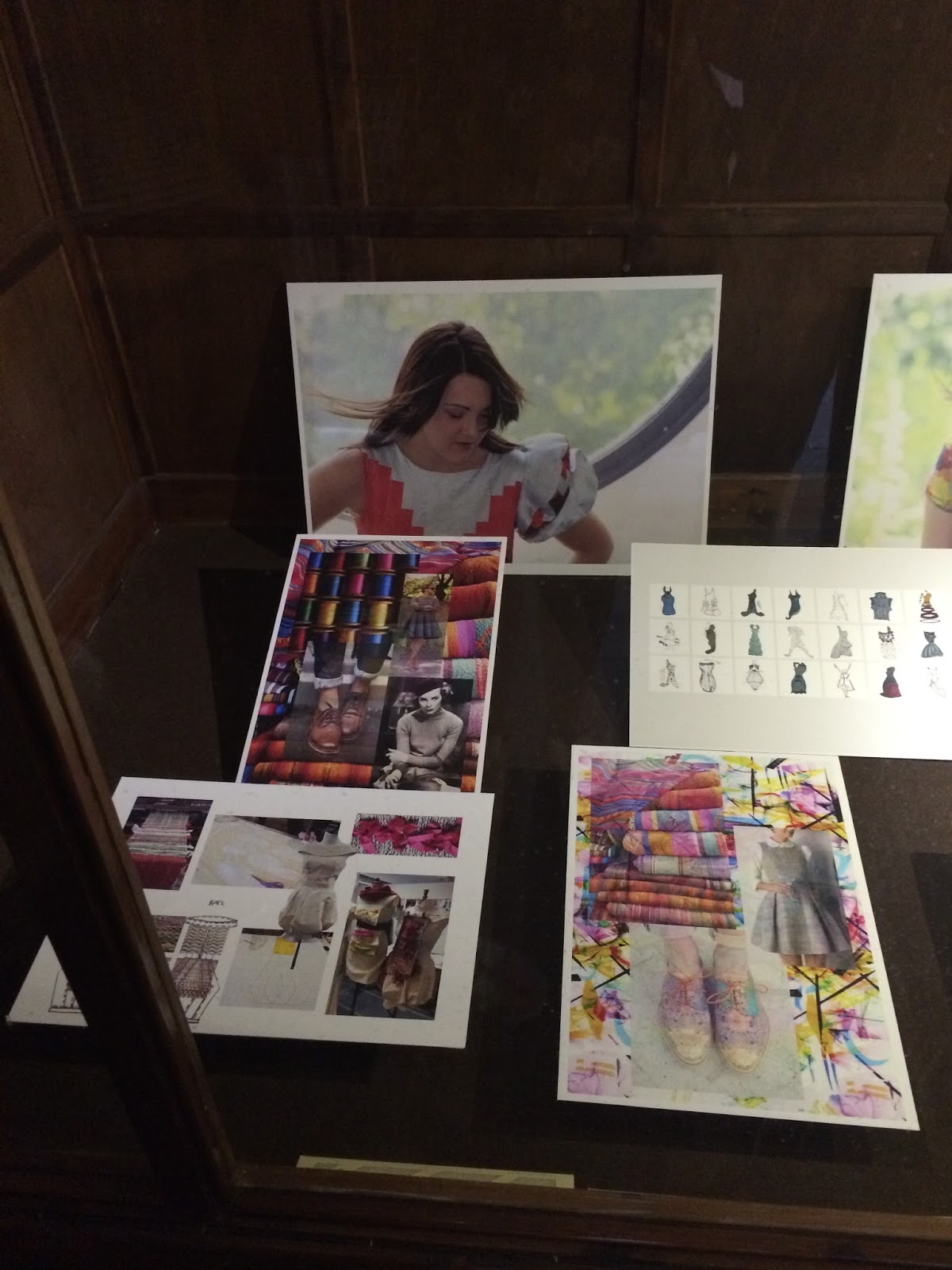
The first and second year degree student's dresses went on display at the Whitchurch Silk Mill for a private viewing before being included as part of an exhibition at the Mill. It was good to see everyone's work on display as I know that we had all put so much effort into creating these special garments. Inside the mill itself are some exhibition spaces where our sketchbooks, samples and photos were on display already. There were some awards given at the viewing too. The exhibition of work will remain at the mill for a couple of months to celebrate the Mill's 200th birthday. Below are some photos taken on the evening of the private viewing.

My dress on display.
All of our dresses on display.

Some of my samples in the exhibition space.
Our groups dresses.
Me with my dress.

Silk Mill dress- catwalk and photoshoot


Below are a few behind-the-scenes photos from a photo shoot of my dress that was made for the Whitchurch Silk Mill exhibition. As well as those from the photo shoot, I've also included pictures of the dress on the catwalk when it featured in the end of year show.

Both at the photo shoot and the show it was great to see the dress being worn and to see that it was a very wearable garment, especially after all the hard work that went into making it. The dress and some of my work as well as some of my fellow student's work is now on display at the Whitchurch Silk Mill as part of an exhibition to celebrate 200 years since it was built.